
The Latest in AI: Tips for Discussing AI Use with Adolescents


In this week’s BAIC Center Newsletter:
Parent’s Corner – “The Continuous Challenge Parents Face with AI”: Xiyun discusses a study on emotional intelligence and AI use affects both parents and adolescents. She gives tips on how to start conversations about AI with this age group.
The Continuous Challenge Parents Face with AI
As AI becomes more common in daily life, many parents may be noticing a growing gap between how they and their teens use it. In this study, adolescents reported using AI more often than parents, especially for school support and behavioral advice. Some also reported sharing personal data with AI and showed greater trust than parents in areas such as AI data security and the quality of behavioral advice.
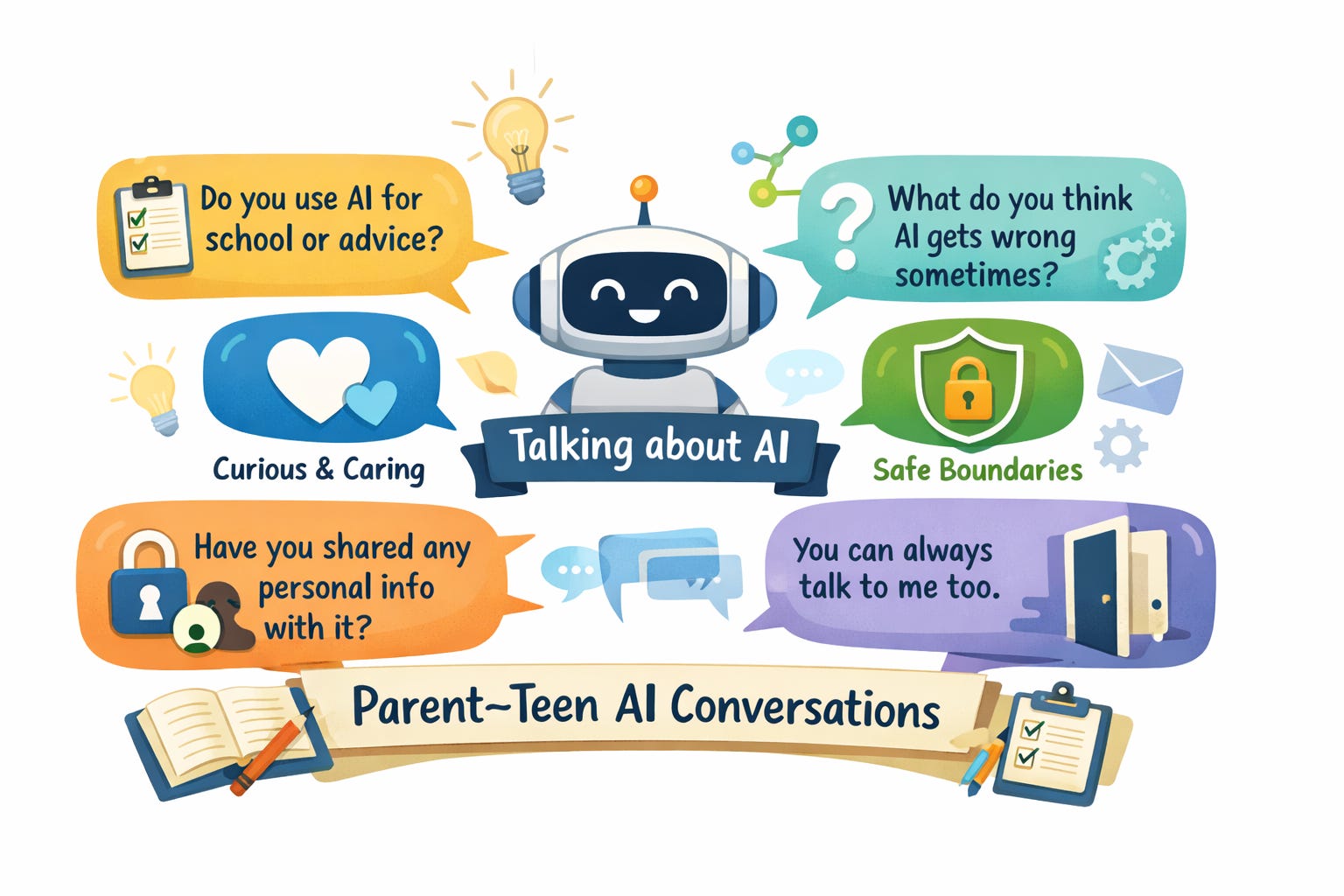
One Tip
Use an authoritative approach: combine warmth, open dialogue, and clear digital boundaries.
Why It Works
Adolescents may be more likely to use AI in a balanced way when parents stay involved, emotionally available, and clear about boundaries. In this study, more balanced AI engagement was associated with authoritative parenting, stronger perceived family support, and higher trait emotional intelligence. The authors suggest that warmth, open dialogue, and clear digital boundaries may help create a digital secure base, so adolescents are not left to navigate AI use entirely on their own.
Try This Script
Use calm, open questions about AI use, behavioral advice, and personal data, while keeping the parent-child relationship involved as a source of guidance and support.
Start with curiosity:
“I know AI is part of daily life now, and I’d like to understand how you use it.”Ask about how they use it:
“Do you mostly use AI for school support, general information, or advice?”Ask directly about advice and privacy:
“Have you ever asked AI for advice on what to do in a situation?”
“Have you ever shared personal information with it?”Encourage critical thinking:
“What do you think AI is helpful for?”
“What do you think it may not be as good at?”
“How do you decide when to trust it and when to double-check it?”Set clear boundaries:
“I’m not saying you can’t use AI, but I do want us to have clear boundaries around personal information and using AI for advice.”Keep the relationship involved:
“If something feels important or personal, I want you to know you can still come to me too. AI can be a tool, but it should not replace support from people who know you.”
Example Scenario
Your teen may use AI for school support, general information, or advice on how to handle a situation. A parent may notice that AI is becoming a regular source of help and may want to open a conversation about privacy, trust, and when AI should not be the main place to turn.
Related Resources for Parents and Families (downloadable)
Talking about AI: A Guide for Families (Internet Matters)
Parent checklist on safe and critical AI use
Family guide on AI privacy and boundaries
Study Source: Piombo, M. A., La Grutta, S., Epifanio, M. S., Di Napoli, G., & Novara, C. (2025). Emotional Intelligence and Adolescents’ Use of Artificial Intelligence: A Parent-Adolescent Study. Behavioral sciences (Basel, Switzerland), 15(8), 1142. https://doi.org/10.3390/bs15081142
Written by: Xiyun Chen

 | A guest post by
|