Human-Centered AI: Advancing Mental Health Care While Safeguarding Children


In this week’s BAIC Center Newsletter:
Clinician’s Corner – Artificial intelligence is rapidly reshaping mental health care. Ella highlights how AI can support early detection and personalized treatment, while also addressing its limitations and evolving role alongside human clinicians.
This Week in AI – As artificial intelligence becomes more integrated into everyday life, its interactions with children raise urgent safety concerns. Tessa examines how designing AI with built-in protections can better address risks to children.
Can Artificial Intelligence Lead to Improved Mental Health Care?
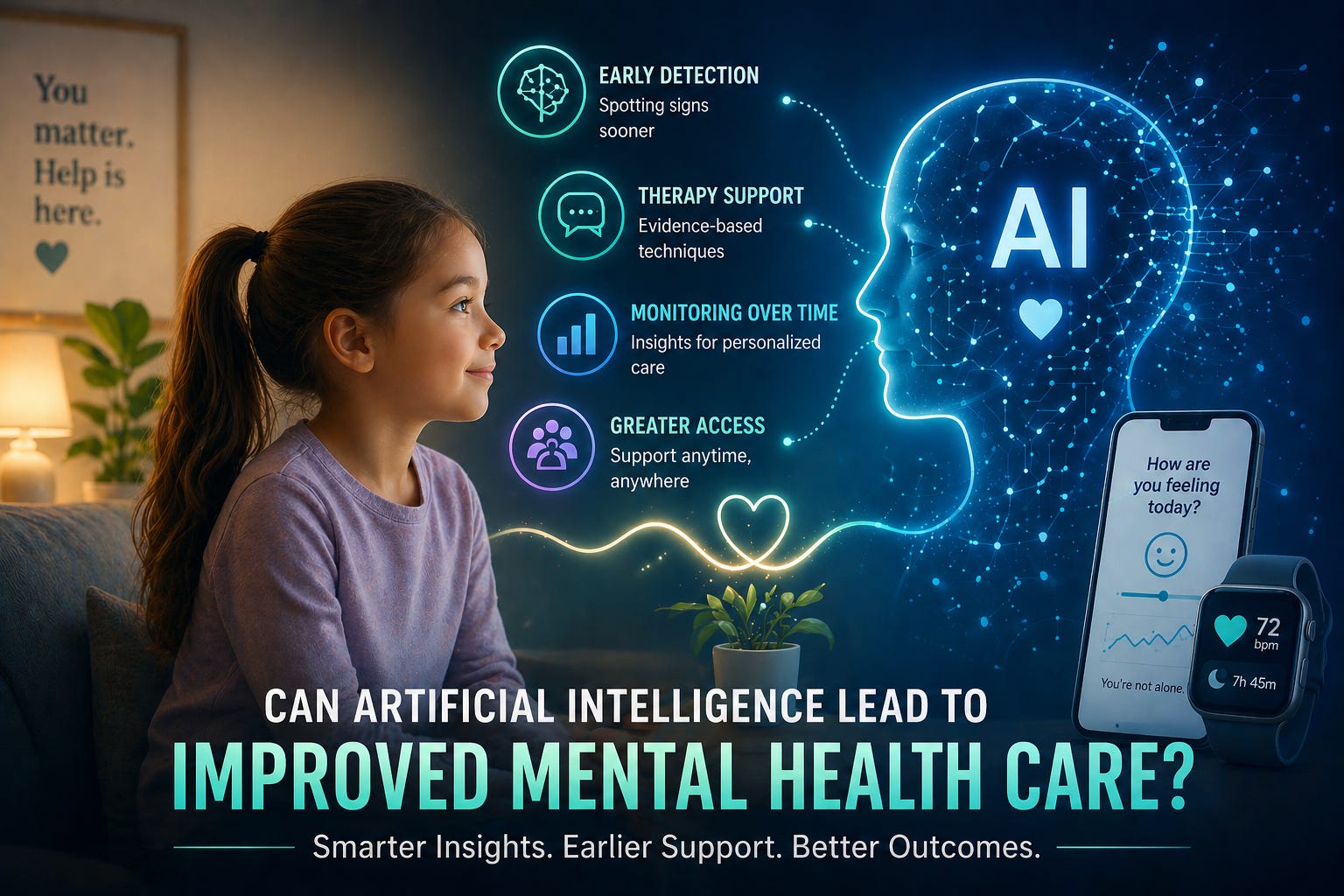
Artificial intelligence is becoming increasingly ingrained in our daily lives, and this is no exception in the world of mental health. AI is already helping mental health professionals through apps, online tools, and chatbots, so researchers are investigating whether AI could enhance personalized care, continuous patient monitoring, and treatment overall.
A 2025 review published in Digital Health examines studies from the past few years to better understand how AI could be used in mental health and its effectiveness. Instead of focusing on just one tool, the researchers looked broadly at how it is being used across diagnosis, treatment, and ongoing support.
How AI is currently used in mental health care
Pattern recognition
AI can detect subtle changes in typing, speech, sleep, and behavior that humans might miss.
Early detection
AI can detect early signs of mental health struggles before individuals notice them.
Therapy support
AI can provide coping strategies, reflective questions, and techniques such as CBT and mindfulness. These are modalities that clinicians utilize frequently.
Accessibility
With AI, mental health support can be available through online platforms. This allows for support to become more widely accessible.
Monitoring over time
AI can track activity, sleep, and behavioral changes using smartphones and other devices. These extra data points help support personalized treatment.
What type of AI systems are being used?
There isn’t just one type of AI used in mental health. In fact, this review identified several main approaches, including machine learning, deep learning, natural language processing, and multimodal artificial intelligence. Machine learning can be used to predict things like whether someone might develop depression or how they might respond to treatment. Building on this, deep learning is more advanced; it can analyze factors such as voice tone or facial expressions to help assess emotions. Additionally, natural language processing enables AI to assess written or spoken language, which is how chatbots or text-based tools can interact with users. Finally, multimodal AI combines multiple types of data, like speech, text, and behavior, to provide a more holistic view of someone’s mental health.
Possible downsides
While many of these tools seem very promising, there are some real concerns that need to be considered…
Privacy
Mental health information is very personal and private, which is why mental health professionals are bound by HIPAA. With AI, people’s data is collected and stored digitally. When that occurs, there’s always a risk that personal health information could get compromised.
Bias
There could be unintentional biases built into artificial intelligence. If AI is trained on limited or non-diverse data, it will not work well for everyone. This can easily lead to inaccurate results, recommendations, or outcomes. When it comes to mental health, these inaccuracies could be extremely detrimental.
Lack of transparency
Sometimes it’s unclear to users how AI systems make decisions. This could make clients and clinicians hesitant to rely on them, especially when it comes to assessment and diagnosis, due to the lack of concrete reasoning.
Affectedness
The research suggests that AI has significant potential but is still developing. Although some tools are already reasonably effective at identifying patterns linked to mental health conditions, these AI tools are still developing.
What does this mean?
Overall, AI could become a helpful tool for mental health professionals. The study finds that AI will be especially helpful for improving access and detecting symptoms early. Despite this, AI should not replace the necessity for human intrapersonal support.
Currently, AI can work alongside therapists, not instead of them. It might be a great tool for both therapists and clients to maximize treatment, but it is not yet ready to replace real human care. The research is encouraging as AI continues to improve, but it also shows that there’s still a lot to figure out as this technology grows and develops.
Referenced study:
Ali, M., Ali, S., Abbas, Q., Abbas, Z., & Lee, S. W. (2025). Artificial intelligence for mental health: A narrative review of applications, challenges, and future directions in digital health. Digital Health, 11, 20552076251395548. https://doi.org/10.1177/20552076251395548
Written by: Ella Garnett
Before the Algorithm Learns: Child Safety Begins at the Data Layer
Category: AI Safety for Children
Source: Child Safety In The Age Of AI: Why Governance Must Begin At The Data Layer
When AI systems interact with children, the central question is whether safety is treated as a design principle from the beginning or an afterthought. Safety features for children include minimizing data collection, enforcing age-sensitive profiling, setting strict lifecycle protocols for minor accounts, and continuously stress-testing for child-specific risks. Central to this is asking what data we truly need to collect in the first place.
Training needs to focus on more cases of dynamic and real-world adverse questions and prompts to prepare for unsafe scenarios with children. This includes real-world risks such as grooming patterns, manipulative conversational tactics, self-harm prompts, and exploitative misuse.
On top of that, including a layer of human oversight is essential. This can account for contextual differences, risk detection and escalation, learning and system improvement, and accountability.
Children are among the most vulnerable populations in the world, and if AI systems are built with their safety in mind, it will lay the foundation for responsible AI development.
Written by: Tessa Laroche