The Latest in AI: Companion AIs and Chatbots in Teen Life


In this week’s BAIC Center Newsletter:
Analysis of Companion AIs: Yun looks into companion AIs, namely Replika and Character AI, along with discussing the potential risks and benefits they may have for users. She breaks these risks down into the 3 dimensions of social skills, social motivations, and moral skills.
News Summary: Tessa shares an article from the New York Times that follows teens who use AI chatbots regularly. In this piece, NYT reporter Kashmir hill looks to discover more about why teens might become chatbot users and the different ways that teens actually use chatbots in the day to day.
Companion AIs and Their Potential Risks/Benefits
With the development of conversational AIs, a subset of them focusing on the features of social companions also increased in both popularity and capability. This subset of conversational AI is called companion AI and some examples of them would be Replika and Character AI. A 2025 article discussed risks and opportunities companion AIs have for users’ social relationships outside their relationship with their AI companions and proposed some ideas for developers (Malfacini, 2025).
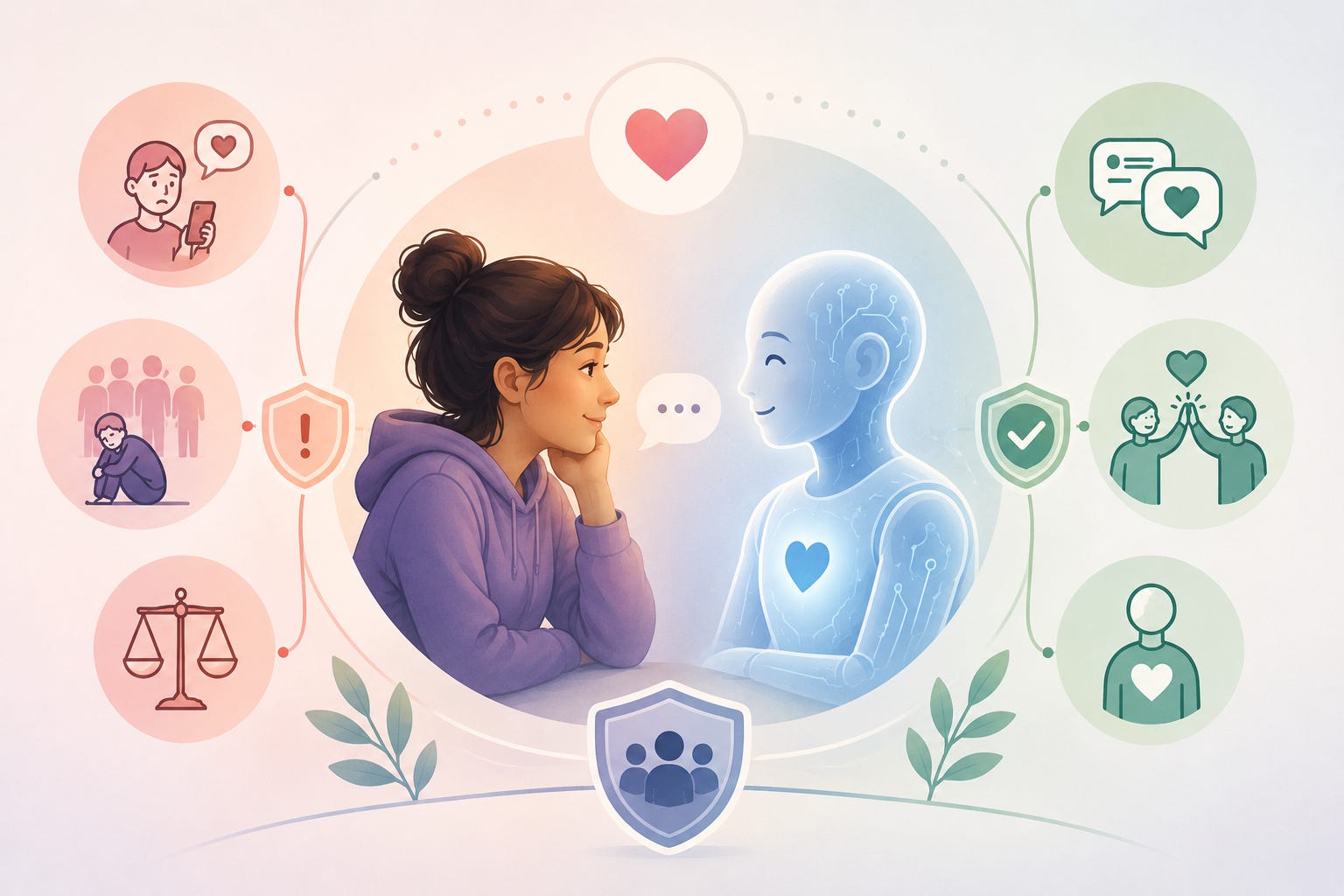
Potential risks and benefits can be presented in three dimensions: social skills, social motivations, and moral skills.
- Social skills:
Risk: Social deskilling- erosion of current social skills or the initiation of poor social skills. Interacting with usually too accommodating nature of AI companions, people might start having unrealistic expectations in their human-human relationships. This might make human-human interaction less fulfilling.
Benefit: Social upskilling-AI companions provide individuals a safe and judgment-free space to practice social skills. This might be particularly helpful for neurodivergent population.
- Social motivation:
Risk: Social deskilling might harm individuals’ confidence and decrease social motivation. Additionally, as human-human relationships get less fulfilling, AI companions have the potential risk of replacing human-human relationships
- Moral skills:
Risk: Normalization of immoral behavior.
With the discussion of risks and benefits, Malfacini further talked how to amplify the benefits and limit the risks with design choices (2025).
- Foster social upskilling with positive reinforcement.
- Highlight negative social skills to users.
- Overtly foster social motivation by directly suggesting users to interact with other humans.
- Subtly foster social motivation showing interest in users’ friends and provide constructive feedback on users’ human relationships.
- Avoid designs of moral appeals to users that could take away their time spent with human companions.
- Provide users with options to sunset an AI companion when it is time to say goodbye.
Recommended reading:
Malfacini, K. The impacts of companion AI on human relationships: risks, benefits, and design considerations. AI & Soc 40, 5527–5540 (2025). https://doi.org/10.1007/s00146-025-02318-6
Sun, X., Wang, Y., & McDaniel, B. T. (2026). AI companions and adolescent social relationships: Benefits, risks, and bidirectional influences. Child development perspectives, 20(2), 91–98. Advance online publication. https://doi.org/10.1093/cdpers/aadaf009
Written by: Yun Xie
A Dive Into How Some Teens are Using Chatbots
Category: Teen Safety
Kashmir Hill, a technology reporter for the New York Times, follows several teens who have made AI chatbots a regular part of their lives, some spending multiple hours a day using them for social, entertainment and comfort purposes. Researchers note that teens who are lonelier or have less social experience tend to be most drawn to these tools, and caution parents that heavy use could have serious consequences. Many teens described getting into chatbots through humor, using characters such as a block of cheese named Cheese who wants to rule the world, but what started as play often deepened into something more. Chatbots were also reported to turn flirtatious without any prompting from the user, raising questions about whether these systems are designed to drive engagement through sexual conversation. Among the teens Hill follows is Quentin, whose chatbot use dropped off significantly after he started dating a friend over the summer. Quentin credited the chatbots with helping him get more comfortable talking about his feelings but said he regretted how much time he spent on them overall. The story highlights how caution and consideration should be given to using AI chatbots since there is a spectrum of interaction from users. The article is a reminder that AI chatbots are becoming a bigger part of teen life, and that there is a fine line between casual use and emotional dependence.
Source: What Teens Are Doing With Those Role-Playing Chatbots - The New York Times
Written by: Tessa Laroche
Our BAIC website has recently been updated. Check it out to see our latest studies on how AI chatbots and AI systems are shaping young people’s relationships, development and well-being.